Skip to content
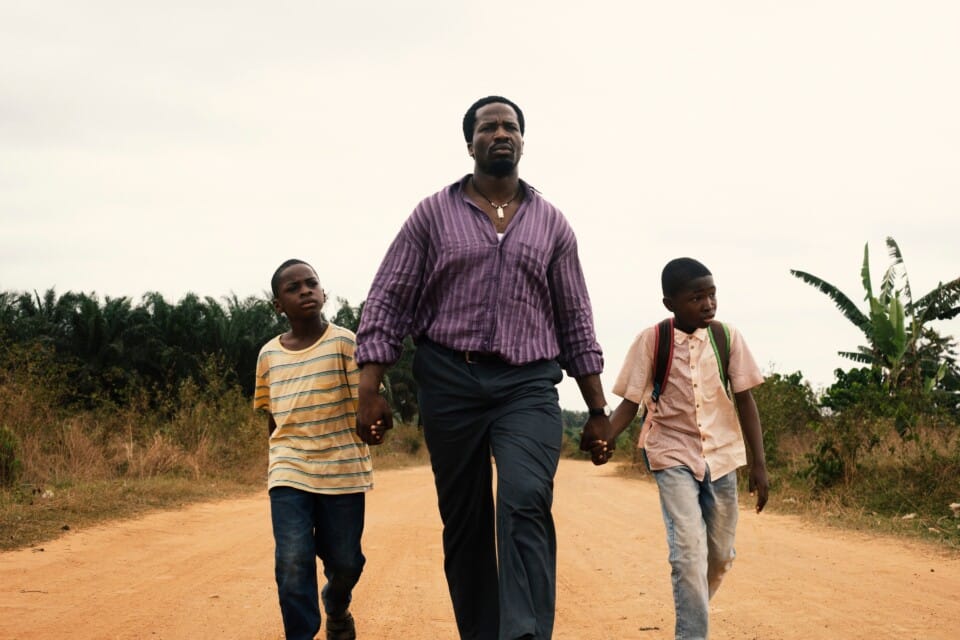
A father is walking with his two sons across a deserted sandy road. The father stands in the middle, holding both of his sons hands as they walk together.

Issue 010 Spring 2026 Interviews

Akinola Davies Jr. on the Unfulfilled Promise of Nigeria

Diaspora and the allure of Lagos in "My Father’s Shadow"

by Kambole Campbell

Courtesy of Mubi


As the United States revives colonialism with anti-immigration policy and aggressive foreign policies, the films of Akinola Davies Jr. feel like a spiritual counterbalance.


The Global North continues to perpetuate the myth of African “savagery,” to reflect a Global South in need of white, capitalist influence to be corrected. Davies’s films, through their intimate stories, show the potential for change already coming from within. 

In his debut feature film, My Father’s Shadow (2025), there’s energy and liveliness in Lagos that permeates with the anticipation of such change. It’s present in how a father guides his boys through bustling marketplaces and bars, showing them the solidarity between people who are hoping for a better future. The refutation of the Global North’s viewpoint of Africa doesn’t mean that Davies’s work lives in ignorance of institutional corruption, however. In Davies’s short film Lizard (2020), a girl quietly slinks amidst dark halls, witnessing underhanded deals in the belly of a megachurch. These deals lead to an armed robbery later in the film, a fearful moment underscored by the desperation that stems from capitalist greed, and reveal an honest and messy humanity. 

Davies’s films are directly inspired by his own experiences of living in Nigeria. This personal lens is a definitive element of My Father’s Shadow. It’s a sensitive and heartrending story of fatherhood amidst social upheaval that challenges colonial notions that Africa was “worse” before the West showed up. It’s also the first Nigerian film to be an official selection of the Cannes Film Festival.1

Co-written by Davies and his older brother Wale Davies, My Father’s Shadow is a semi-autobiographical film that follows the young boys Akin and Olaremi on a pivotal day in Nigerian history: the 1993 election. It was the first after a decade of military rule following the 1983 coup, with Moshood Kashimawo Olawale Abiola as a candidate and leader of the Social Democratic Party. His victory was annulled by then–military leader Ibrahim Babangida, leading to civil unrest and lasting consequences for the country’s political structure. Davies shoots the film through a lens of nostalgia and emotive camerawork (like he does in Lizard) to capture the perspectives and inner lives of his characters. The power of My Father’s Shadow lies in how it ties together Nigeria’s history with a vision of the father that the Davies brothers never got to have a relationship with.2 In the film, he’s played by the magnetic Ṣọpẹ́ Dìrísù, perhaps best known for the 2020 horror film His House and the action series Gangs of London (2020–). 

Akin and Olaremi are played by real brothers, the child actors Godwin Chiemerie Egbo and Chibuike Marvellous Egbo, who are also not-quite stand-ins for the screenwriters. The two brothers spend a day in Lagos with their father, Folarin (Dìrísù), who is often absent due to his job in the city. Seen through the boys’ eyes, there’s a visual allure to the busy urban spaces of Lagos, but also a sense of danger as the film builds mounting political tension. These elements combine to tell a story of both a country and a parental relationship that could have been.  Seen spoke to Davies about the personal and logistical challenges of making the film, the director’s relationship with the diaspora, and Nigeria’s relationship to the Global North.
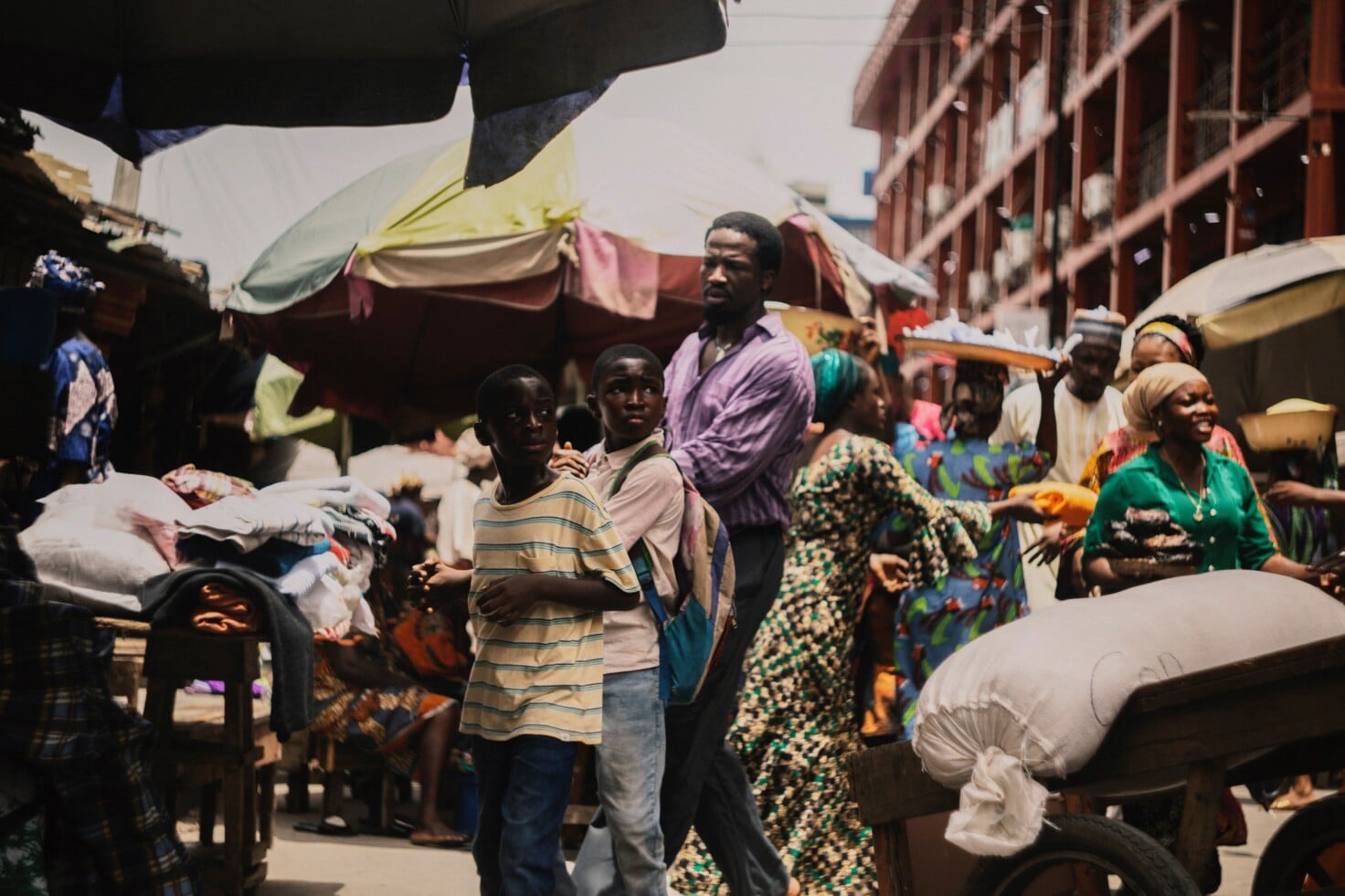
The father and his two sons are walking together down a crowded city street, holding hands as they navigate between people.
Courtesy of Mubi

Kambole Campbell: The beginnings of My Father’s Shadow came from your brother sending you a script about you getting to spend a day with your father. What made the specific day of the June 1993 election annulment the desired backdrop?

Akinola Davies Jr.: The day itself represented a flashpoint that also mirrored our story, both the unfulfilled promise of getting to grow up with your father and the unfulfilled promise of the strength of Nigeria. We both grew up in Lagos, and we remembered it being quite harrowing for a lot of people, especially my mother’s generation. I think my mum would have been in her mid or late 50s. I remember being pulled out of school and having to have a bit of flora3 on your window to show that you were with Abiola and not with the military. It was quite intense. 

The story of Abiola mirrored our story in many ways, this mercurial character who was supposed to become the father of the nation. And the nation was trying to re-engage in this idea of democracy under this person who, for all intents and purposes, ticked every box: he represented a businessman, astute diplomat and politician, a philanthropist, someone who’s very invested through his marriages to many different tribes and factions within the country. 

So it drew a parallel for us with the boys’ side. There’s this promise of spending time with their father and getting to know the world and growing, with the country growing through the stewardship of this statesman. 

June 124 has since become a national holiday. I think the last president, Buhari5, accepted that it was a stain on Nigerian contemporary history, which is great for us because we were in production when we found this out. It was just also a day in contemporary history that loads of Nigerians in the diaspora aren’t all aware of because of how it was buried in history under this brutal military dictatorship. 

KC: You grew up in Nigeria, but you were also educated in Europe and America. How did that time away from Lagos influence your view of the city now?

ADJ: It’s definitely made me romanticize my childhood, going back to Lagos and Africa in general. This idea of colonization makes you believe that Europe is the place that you wanna be and that it’s amazing. 

Whereas now, I think it’s brainwashing to make you believe that everything in the West is the best. So I doubled down on this romanticization of being African and my relationship with Nigeria. 

I think learning and understanding our histories and giving some context as to how these events happen helps counterbalance ideas about the country. I think art and storytelling can help give a lot more context and show that things aren’t as straightforward.


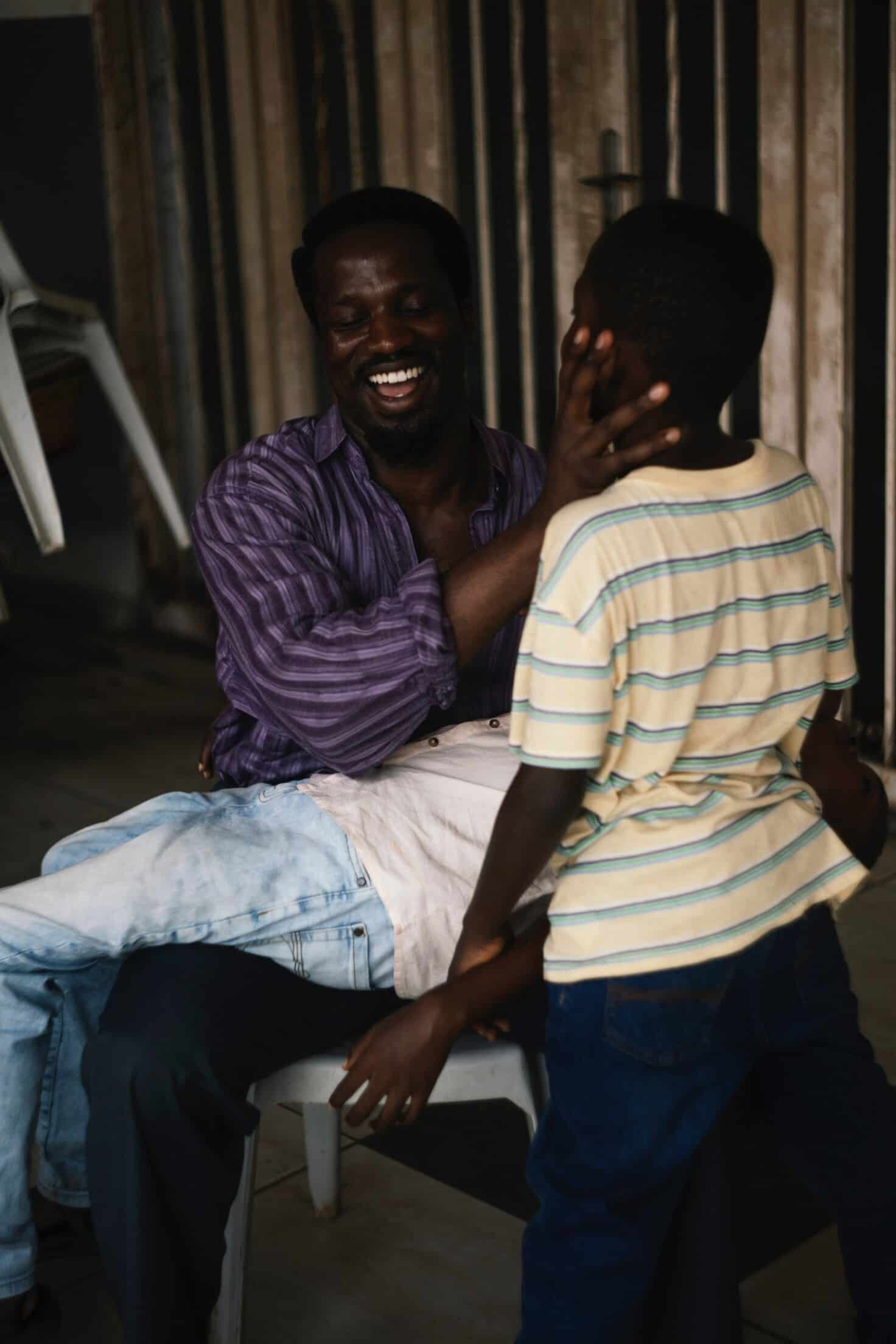
The dad is sitting in a chair, smiling, with one son lying on his lap and the other standing in front of him.
Courtesy of Mubi

KC: This is something I found interesting about your short film Lizard, which contrasted a family being robbed outside their megachurch with the church’s own corruption. What was the initial spark for that film? 

ADJ: We were robbed at gunpoint when I was 7 or 8. When I wrote the story and sent it to my brother and my cousin, they were so surprised about how much detail was from memory, considering we never really spoke about that day. Maybe it’s in the consciousness of children, or certainly Nigerians, that we’re quick to just block things out. You’re meant to just keep it moving, basically. 

The premise for writing it was to understand the context in which a bunch of children would get robbed at a place of worship on a Sunday at gunpoint. One perspective is, yeah, the robbers are the bad people, and the churches are the good people. That’s a very simplified way of seeing it, but actually it takes a certain level of desperation for people to be able to do that. And instead of demonizing that desperation, the film is trying to understand the systems at play, realizing that the middle class and the upper middle class and the nouveau riche have a part to play here too. 

KC: My Father’s Shadow is not your first time directing child actors. Was there anything specific from the experience of working on Lizard that you were carrying forward into your work with the boys in the feature film? 

ADJ: Pami Larry, who was in Lizard, was just the best actor I’d come across. She must have been the same age as Marvellous, about 12. Working with someone who’s just so curious and keen at such a young age, their default setting is brilliant. So you think about things such as: how do you protect that? How do you embellish that? How do you treat them as an equal and encourage them to lean into their instincts? 

It’s kind of weird saying this as a director: I’m actually not trying to get performances out of people. I just want them to give me what they want to give me, because they’re cognizant and intuitive enough to already know what they’re supposed to be doing.

KC: You’ve said in earlier interviews that you didn’t get to spend time with your father. I’m curious as to how Ṣọpẹ́ Dìrísù’s performance as the boys’ father, Folarin, worked with what you called a “confluence of memory, dream, and hearsay.”6

ADJ: It’s quite a hard one, because we told Ṣọpẹ́ to just be free, to not have to carry this idea of wanting to be our father. Funnily enough, by giving him some distance, he probably did an even better job of being that. I showed him pictures, but the thing is that we didn’t even really know our dad. So it’s actually easier for us to ask Ṣọpẹ́ to be his version, his interpretation of who this person is. 

Everything we learned about our father we were able to pour into the character, in terms of how people revere him and how people look up to him. But also, [Folarin]’s not perfect; he still has flaws. [Ṣọpẹ́] did a masterful job because he was coming in as a British Nigerian who hadn’t spent a huge amount of time in Nigeria, having to learn the dialect, having to learn tribal language and perform in front of a group of very critical people. It takes a measure of a man to really not wilt in that situation. 


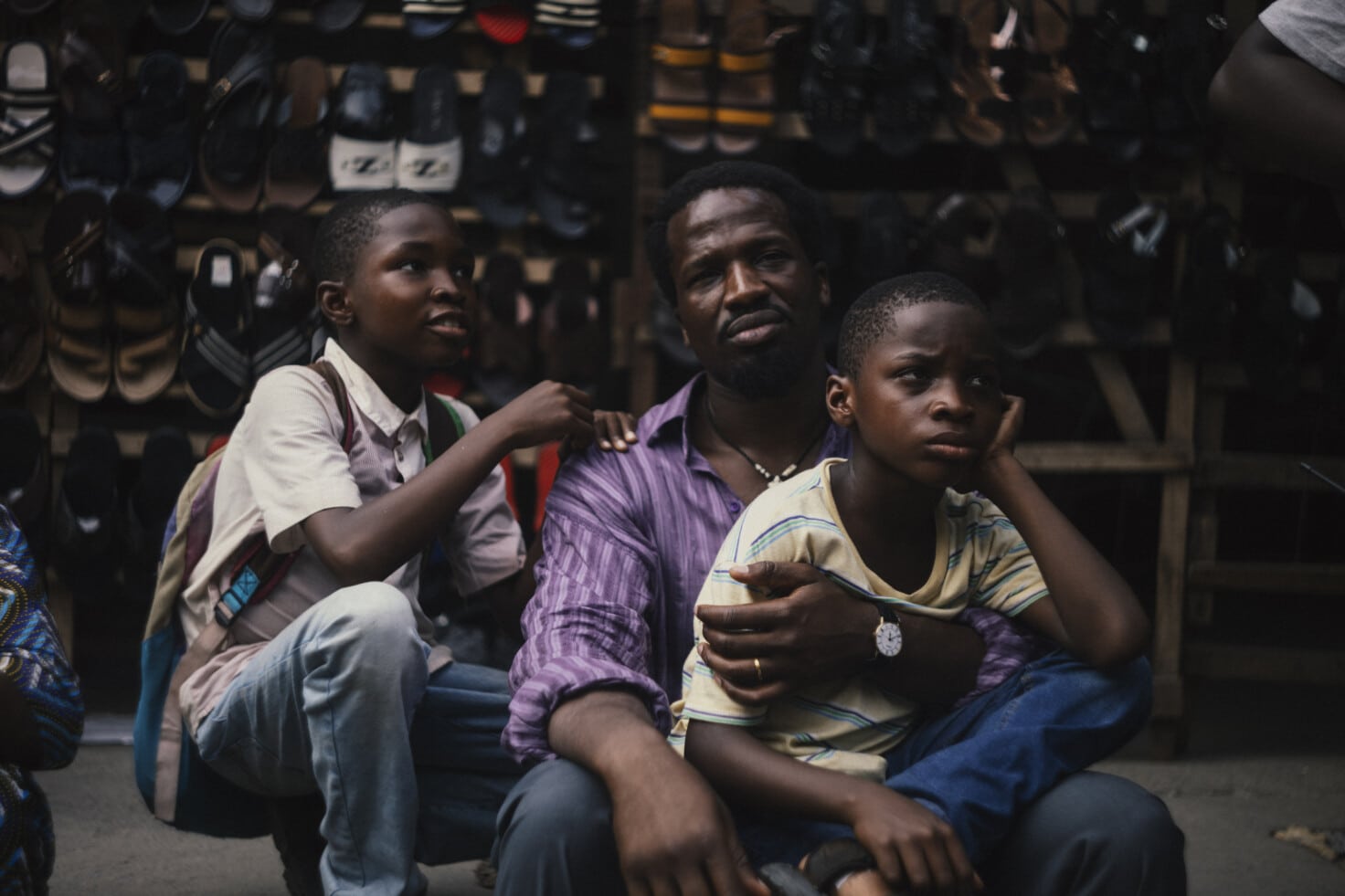
The dad is sitting down, one of his sons sits on his lap with legs crossed, and the other son is crouched down next to them.
Courtesy of Mubi

KC: What you said about vulnerability reminded me of one of my favorite scenes in the film, the scene at the beach where the boys learn how to swim but also learn about their father’s personal struggles. What was it like shooting that scene?

ADJ: That was the worst two days of shooting for me because we were supposed to shoot on a different beach. 

Nigeria is one of the few places that’s claimed back quite a significant amount of land around the ocean, but the beaches that would have been present in ’93 are completely eroded. Lagos is one of the few places where local people don’t have access to the beach, so you have to get on a boat or drive really far out. And those far-out beaches were just not fit for purpose because of the pollution in the water. I decided to use my weight as a director to insist we shoot on another beach, where you have to take a boat to. 

Then it was just a confluence of things. We got the boys swimming lessons, but the water was really rough that day, and they were freezing. So the playful stuff was easy, but the more emotional stuff was a lot harder. I had to lean on my producer Rachel, who said, “Let’s just get a clean take on the beach and then see if we can salvage anything from the water.” Which was a genius idea, because we got two or three takes right at the end of a whole day of being battered by the sun.

Finding all the shots and positioning them in 30°C to 38°C heat was not easy. There’s no shade on the beach. You’re exposed to the sun at its most intense, and we needed to shoot in sunlight. You have a big crew, so you have to put everyone in a tent somewhere. Logistically, it’s a lot. Even just talking about it is stressing me out a little bit!  

KC: It’s wild hearing it was that much of a task. It felt like a very natural scene to me.

ADJ: Every small detail in that scene took an extra 10 percent. Filming the conversation in the water felt like a great idea, but you need lifeguards positioned in places so you don’t see them on camera. The sound team was holding up the wires so they didn’t get in the shot. I’m so glad we stuck together and got it done. Shout out to our First AD [Ade Oshin] as well. 

KC: The scale is so different from your prior work, like commercials for fashion labels and your music videos as well. I saw you directed the “Charcoal Baby” music video for Dev Hynes.7 How did working on those inform your current work, if at all?

ADJ: Shooting commercial work helped me understand aesthetics and how to frame something in a beautiful way. The bottom line of shooting fashion and maybe even music videos is that people wanna look beautiful, in their best light. It also made me realize, sometimes you don’t want to do that. Making a lot of short-form stuff allowed me to understand the images I like to create and how to aesthetically document a community in a way that feels visually seductive or engaging. And then there’s set etiquette. No amount of shots can prepare you for the colossal effort that a feature requires. 

There’s also learning to appreciate technicians in hair, makeup, all of those different departments, because everything everyone does is just crucial to how an image is created. Everything is intentional. It’s funny: people always watch something in a film, or some execs would watch in the edit, and be like, “Oh, this thing is doing this thing. Do you know what that means?” And I’m like, “Yeah, I know what everything means.” 

KC: You’ve spoken about the media shaping the perception of Africa in Western countries. What are you hoping your own films are in dialogue with in this regard?

ADJ: That’s something I always try to dance around answering! I grew up on predominantly American television, which I think most Africans, at least in the Anglophone countries, did. 

[My Father’s Shadow] discusses the idea that we’re always having to lean into whatever is happening in the rest of the world and to some extent neglecting what’s happening in our own communities. I guess maybe that’s what the dialogue is. We are part of that global conversation because the diaspora is so huge and because of what Nigerians tend to achieve globally, whether they choose to represent Nigeria or not. In terms of my work, I feel like it’s way too early to say what I’m trying to achieve. I just want to remind people of how textured and incredible our histories are, and to humanize ourselves as opposed to always looking to the Global North.


Footnotes:

1 Page, “Nigerian cinema in the spotlight as ‘My Father’s Shadow’ to premiere in Cannes Film Festival first,” CNN, April 10, 2025, https://edition.cnn.com/2025/04/10/style/my-fathers-shadow-cannes-film-festival-nigeria-first. 

2 Jake Coyle, “Cannes standout ‘My Father’s Shadow’ marks a historic first for Nigeria,” AP News, May 19, 2025, https://apnews.com/article/cannes-nigeria-fathers-shadow-35c58102da6fd2174d0bd110844723b2. 

3 After the annulment of the June 1993 Nigerian presidential election, people used leaves, palm fronds, or tree branches to safely signal their opposition to the military and support for Abiola.

4 The date of the election.

5 Muhammadu Buhari was president of Nigeria from 2015 to 2023. In the 1980s, he ruled as a military dictator, though his recent terms as president were through democratic election. Buhari passed away in July 2025. 

6 Coyle, “Cannes standout.” 

7 The artist known as Blood Orange.